

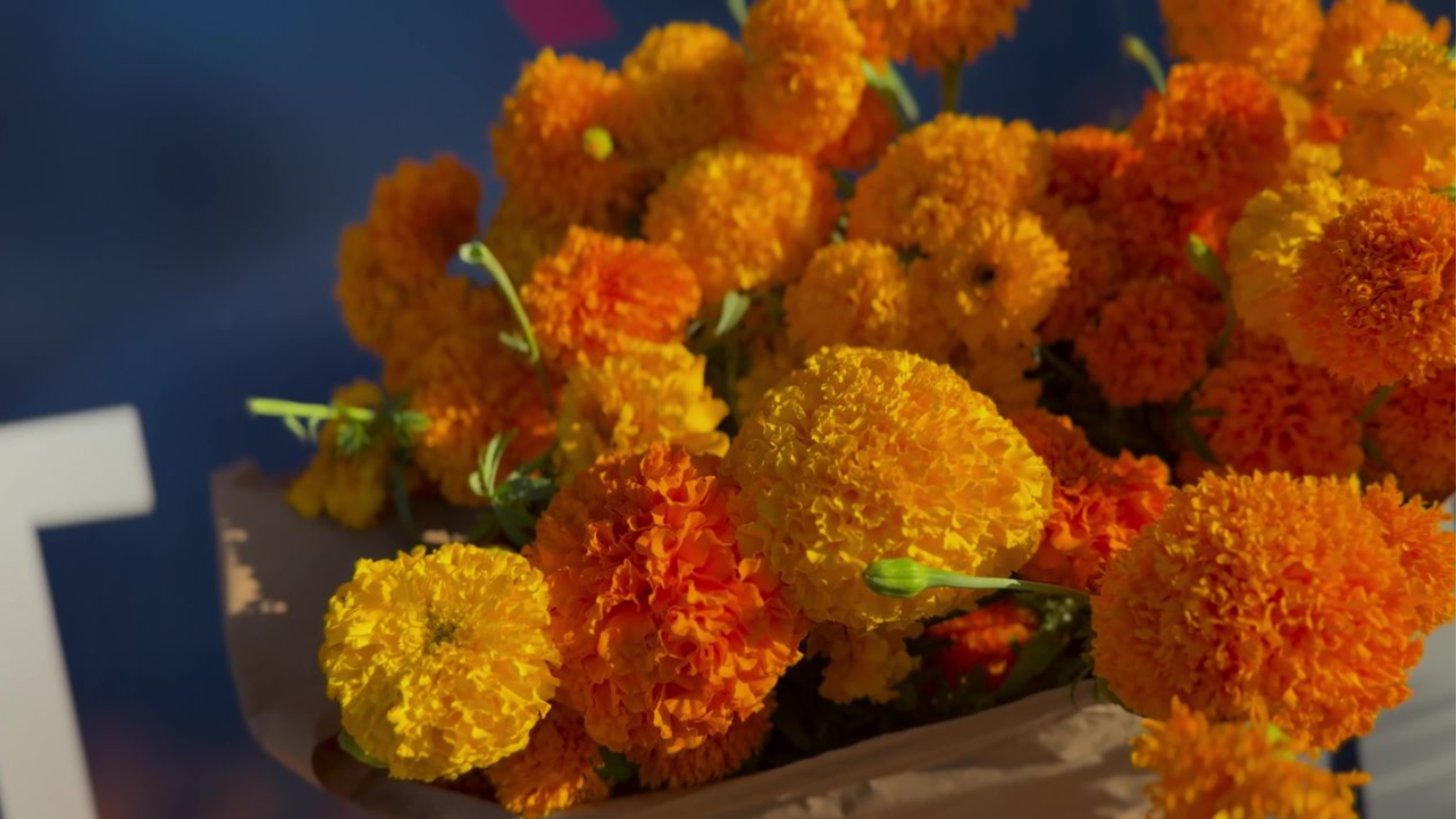


Exhibition Of Ofrendas from October 1st – November 1st 2026
Each year, Arte Américas celebrates día de Muertos through an exhibition of ofrendas. The exhibition invites artists and community members to reflect on the meanings of life, remembrance, and ancestry by creating offerings to individual loved ones or interpretations of a shared theme.
This year’s exhibition, Cuatro Puntos, centers the four directions: North, South, East, and West. Through an open call, we invited community artists to propose an ofrenda that honors the cultural, artistic, or spiritual significance of one of the four directions.
Across las Américas and around the world, Indigenous peoples and diverse communities understand the four directions through distinct histories, cosmologies, teachings, and traditions. Directions may be associated with colors, animals, ancestors, spirits, virtues, seasons, elements, deities, stages of life, knowledge, or gender.
Rather than favoring a single interpretation, this exhibition offers a window into the diverse cultures, stories, and traditions of artists in the Central Valley. Through these ofrendas, we hope to foster dialogue, remembrance, and meaningful connections across communities, generations, places, and time.
Ofrenda locations:
North:
Consulate of Mexico in Fresno, located at 7435 N Ingram Ave, Fresno, CA 93711
South:
Mundo Pol
1418 Fulton St., Fresno, CA
East: Betty Rodriguez Library
3040 N Cedar Ave, Fresno, CA 93703
West: Fresno Chafee Zoo
894 West Belmont Avenue, Fresno, CA 93728
Ofrendas will be on display at Tioga Sequoia Beer Garden from November 2nd to November 8th located on 745 Fulton St Fresno, CA 93721
Featured Artists:
- Amy Díaz-Infante Siqueiros
- Andrea Cano Torres, Rosa Gamez and Carol Padilla — Bullard Dual Language Immersion, AP Spanish Fresno Unified Latinx Student Union
- Camille Herrera-Cockerham
- Edén Santos
- Janel Claybon
- Juan José Valdez Hirales
- Liv Styler
- Roeski Doeski & Jennie Guerro — Hella Fresno
Continue through the exhibition to explore the artists and works that make up this year’s exhibition.
Cada año, Arte Américas festeja el Día de Muertos con una exposición en la que se invita a artistas y a la comunidad a reflexionar sobre el significado de la vida y a conmemorar a nuestros antepasados, dedicando ofrendas a seres queridos o interpretando un tema en común, ya sea cultural, artístico, o espiritual.
La exposición de este año, Cuatro Puntos, se enfoca en los cuatro puntos cardenales: Norte, Sur, Este, y Oeste. En el continente americano, así como en todo el mundo, los pueblos indígenas y diversas comunidades interpretan las cuatro direcciones a través de historias, cosmologías, enseñanzas, y tradiciones distintas. Estas interpretaciones comúnmente se asocian con los colores, animales, antepasados, espíritus, virtudes, estaciones, elementos, dioses, etapas de la vida, conocimientos, o género.
Más que favorecer una sola interpretación, esta exposición brinda una muestra de las diversas culturas, historias, y tradiciones que representan a los artistas del Valle Central. A través de estas ofrendas, esperamos fomentar el diálogo, la conmemoración, y las conexiones importantes entre comunidades, generaciones, lugares, y épocas.
Unicaciones de las Ofrendas:
Norte:
Consulado de México en Fresno
7435 N Ingram Ave, Fresno, CA 93711
Sur:
Mundo Pol
1418 Fulton St., Fresno, CA
Este:
Biblioteca Betty Rodriguez
3040 N Cedar Ave, Fresno, CA 93703
Oeste:
Zoologico Chafee de Fresno
894 West Belmont Avenue, Fresno, CA 93728
Artistas de la exposición :
- Amy Díaz-Infante Siqueiros
- Andrea Cano Torres, Rosa Gamez, Carol Padilla, Bullard Dual Language Immersion, AP Spanish, and Latinx Student Union
- Camille Herrera-Cockerham
- Edén Santos
- Hella Fresno (Roeski Doeski and Jennie Guerrero)
- Liv Styler
- Janel Claybon
- Juan José Valdez Hirales
Continúe su recorrido por la exposición para conocer a los artistas y las obras que forman parte de la muestra de este año.
North: Mexican Consulate of Fresno
7435 N Ingram Ave, Fresno, CA 93711
The Border Between Dream and Reality
Artist: Liv Styler
Direction: North
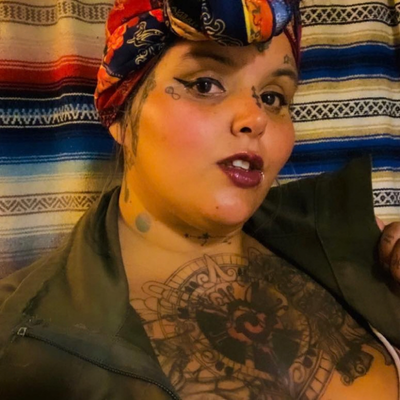
I’m a Chicana mother, journalist, educator, organizer, and artist whose work sits at the intersection of culture, community, and social science. My mission is to tell stories that drive change and center radical joy, BAMN. Art is another dimension of my storytelling. My mixed-media collage work, built from materials donated by loved ones, explores transformation and worth by turning what’s discarded into something valued.
Gallery
Ofrenda Statement:
An altar for Día de Muertos is a place of return: a space made with photographs, offerings, color, scent, and memory to welcome our loved ones home. We place what they loved there, not because grief disappears, but because remembrance gives it somewhere to go.
For me, storytelling carries a similar responsibility. It is how we hold our people close, protect cultural practice, preserve memory, and refuse to let the lives that shaped us become footnotes. To know our ancestors is not simply to know their names or where they came from. It is to ask what they endured, what they dreamed of, what they left behind, and how their choices became part of the lives we carry forward.
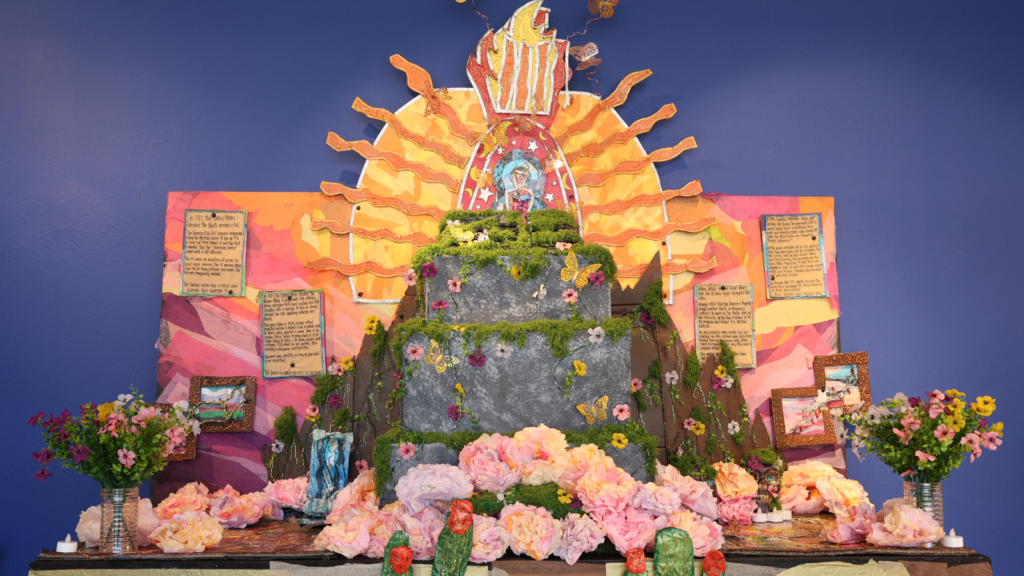
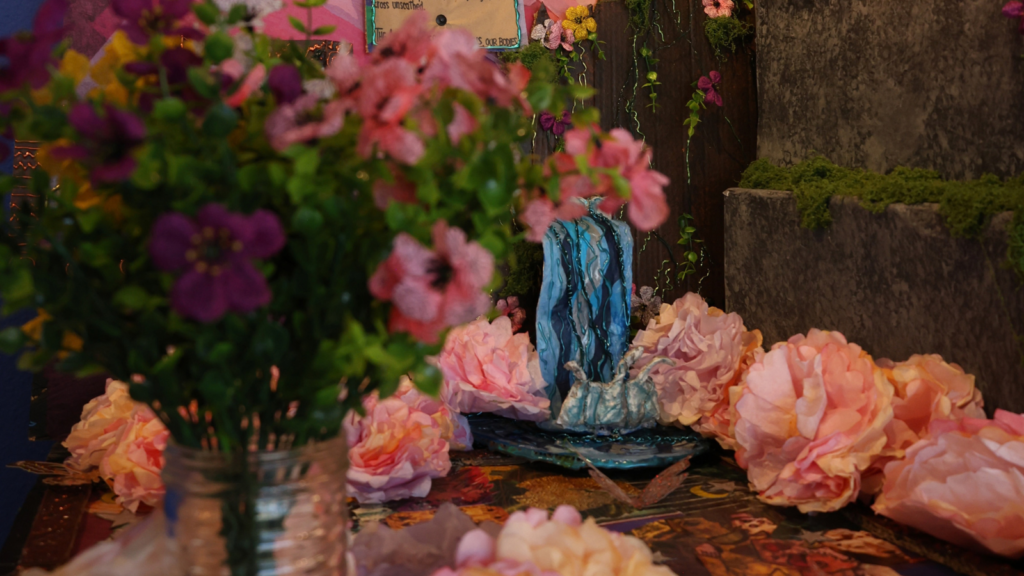
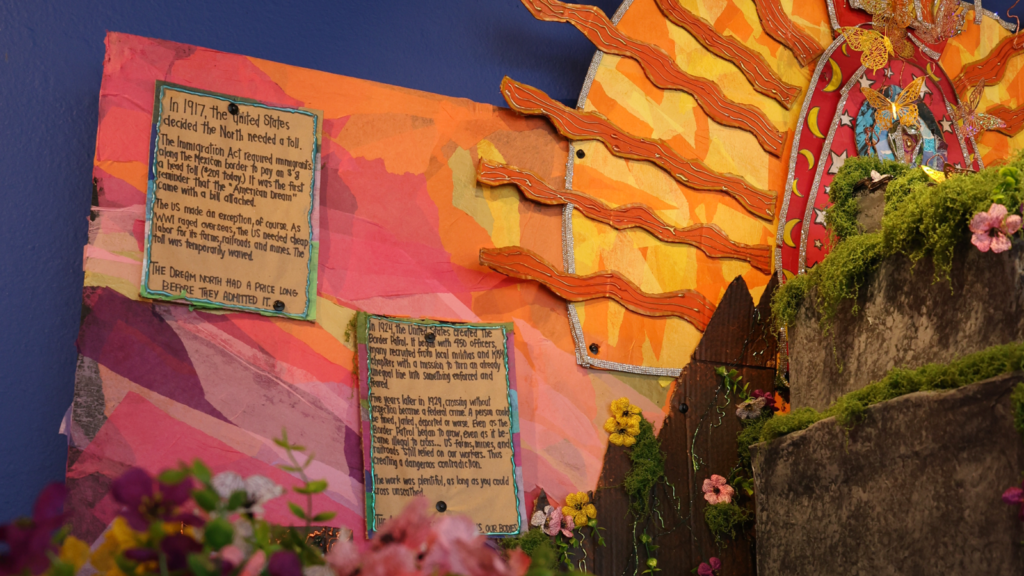
For *Cuatros Puntos*, I wanted to create an altar that moved beyond my own family while remaining rooted in it. This installation honors the many people who have traveled north across the border in search of the promise often called the American Dream: safety, freedom, stability, work, and a future that felt possible. It honors those who arrived, those who did not, and those whose journeys continue through the stories their families carry. My family came from Oaxaca, traveling by train toward El Paso during a time when crossing could still resemble a passage rather than a punishment. Over generations, that journey has changed. Train tracks that once suggested movement and possibility have increasingly given way to fences, desert crossings, barbed wire, detention, disappearance, and death. The desire for safety has not changed, but the conditions surrounding it have hardened.
The altar draws from Monte Albán in Oaxaca, where my family originates, as well as the convergence of Tonantzin and the Virgen de Guadalupe. Together, they reflect an intersection of Indigenous spiritual traditions and the layered reality of colonization. Its diverging paths reflect the changing shape of migration. One recalls the railroad. Another confronts the border as a barrier. I chose not to use real photographs. This altar honors people whose names and faces have too often been made invisible, and I wanted to create tribute without turning anonymous loss into imagery for consumption. Instead, I turned to collage. Like gathering the broken pieces of a vase or assembling a jigsaw puzzle without the reference image, each fragment carries something: a place, a memory, a wound, a dream. Together, they create an emotional landscape of what it means to leave, to hope, and to survive. Rooted in the colors, offerings, and visual language of Día de Muertos, this altar extends the tradition into collective remembrance. Located in the North section, it follows the direction generations have traveled toward an imagined future. It is for those who made the journey, those still making it, and those who never reached the other side. It is a place of mourning, but also of witness.
La Frontera entre los Sueños y la Realidad
Por: Liv Styler
Dirección: Norte
Soy una madre chicana, periodista, maestra, activista, y artista cuyo trabajo se encuentra en la intersección entre la cultura, la comunidad, y las ciencias sociales. Mi misión es contar historias que impulsen el cambio y se centren en la alegría radical, BAMN. El arte es otra dimensión de mi forma de contar historias. Mi obra de collage en técnica mixta, creada a partir de materiales donados por mis seres queridos, explora la transformación y el valor al convertir lo que se desecha en algo valioso.
Reseña de Ofrenda:
Un altar del Día de Muertos es un lugar de retorno: un espacio elaborado con fotografías, ofrendas, color, olor, y memorias para dar la bienvenida a casa a nuestros seres queridos. Ahí incluimos lo que amaban, no por que el dolor desaparece, pero por que el recuerdo le da un lugar hacia donde ir.
Para mí, el contar historias lleva una responsabilidad similar. Es cómo nos mantenemos cerca de los nuestros, protegemos nuestras prácticas culturales, preservamos recuerdos, y nos negamos a dejar que aquellos que nos formaron queden a una nota al pie de la historia. El conocer a nuestros ancestros no solo es saber sus nombres o de donde vinieron; es el preguntar lo que aguantaron, lo que soñaron, lo que dejaron atrás, y cómo sus elecciones formaron parte del presente de nuestras vidas.
Para “Cuatro Puntos,” quise elaborar un altar que va más allá de mi propia familia y al mismo tiempo quedar arraigado a ellas. Esta instalación honra las muchas personas que han viajado al norte cruzando fronteras en busca de la promesa del tal Sueño Americano: La seguridad, la libertad, la estabilidad, el trabajo, y un futuro que se siente posible. Rinde homenaje a quienes llegaron, a quienes no lo lograron, y aquellos cuyo vie continúa a través de las historias que llevan sus familias. Mi familia es oriunda de Oaxaca, viajando en el tren hacia El Paso en los tiempos en el que cruzar podría verse como un trayecto y no un castigo. A lo largo de generaciones, este viaje ha cambiado. Las vías del tren que antes significaron el movimiento y la posibilidad han dado paso a cercas, cruces por el desierto, alambres de púas, detenciones, desapariciones, y muerte.
Legacy Never Dies
By: Andrea Cano Torres, Rosa Gamez and Carol Padilla, Bullard Dual Language Immersion, AP Spanish and Latinx Student Union
Direction: North
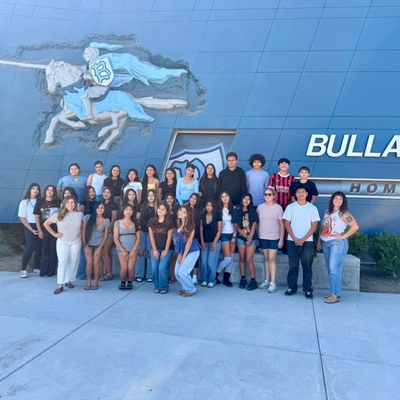
A collaborative of Bullard Students that are in Advanced Spanish for Dual Language Immersion, Advanced Placement Spanish Language and Culture, Native Speaker II, and Latino Student Union has created this altar and ofrendas, led by our very own talented local artist, Andrea Cano Torres.
Rosa Angelica Gámez instructor for all involved courses and Bullard LSU advisor in partnership with Carol Padilla, District Latino Student Union manager.
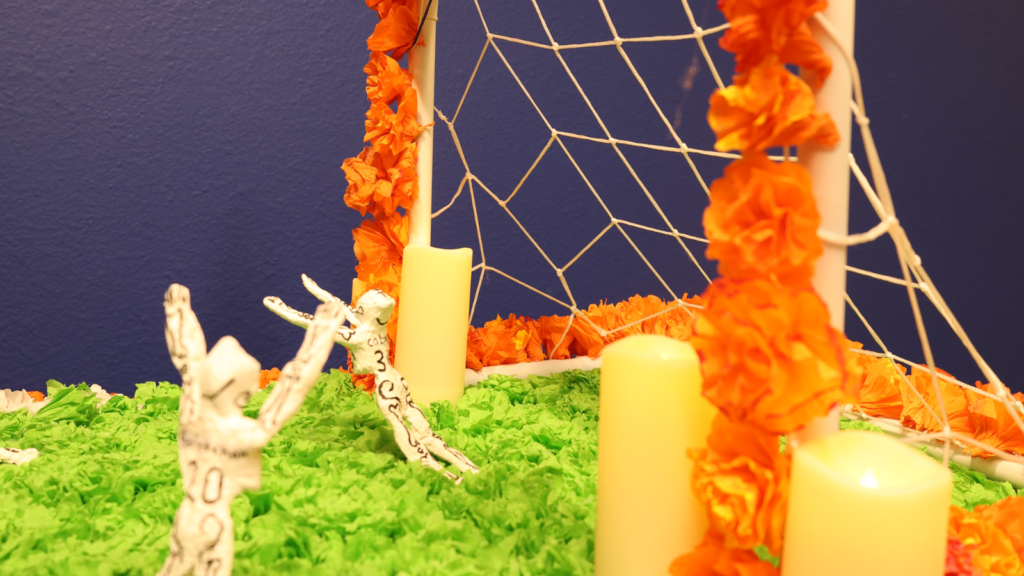
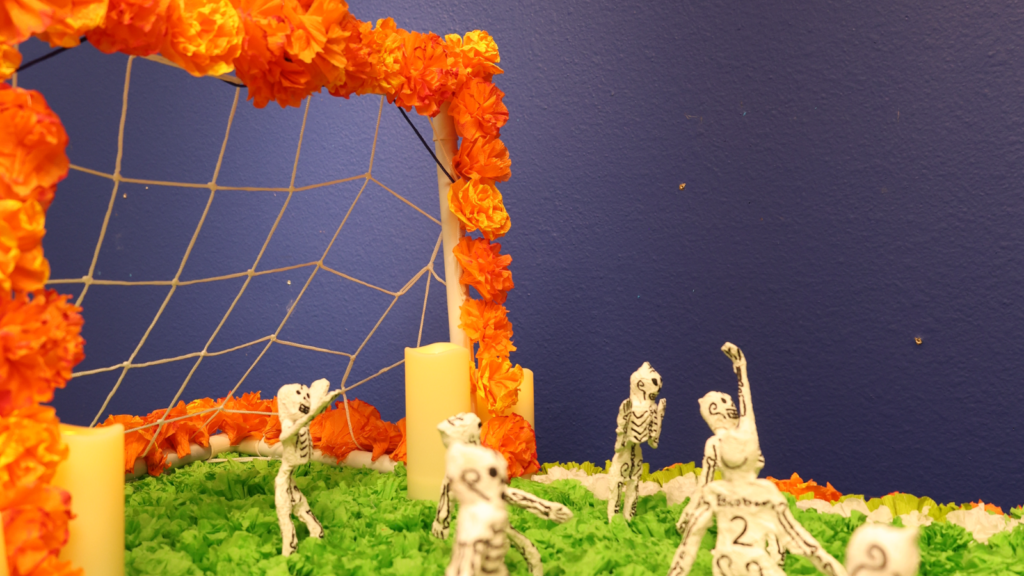
Ofrenda Statment:
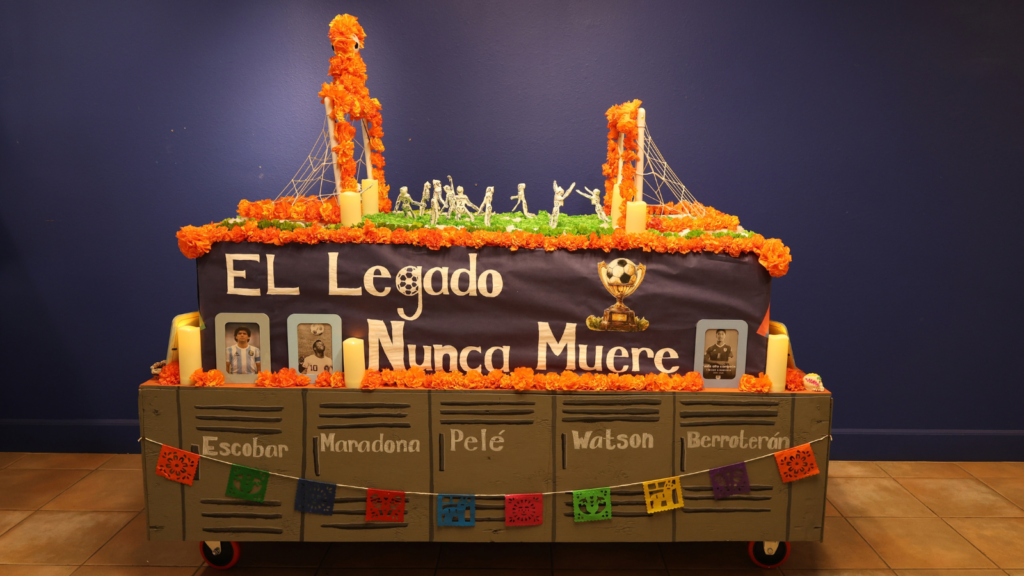
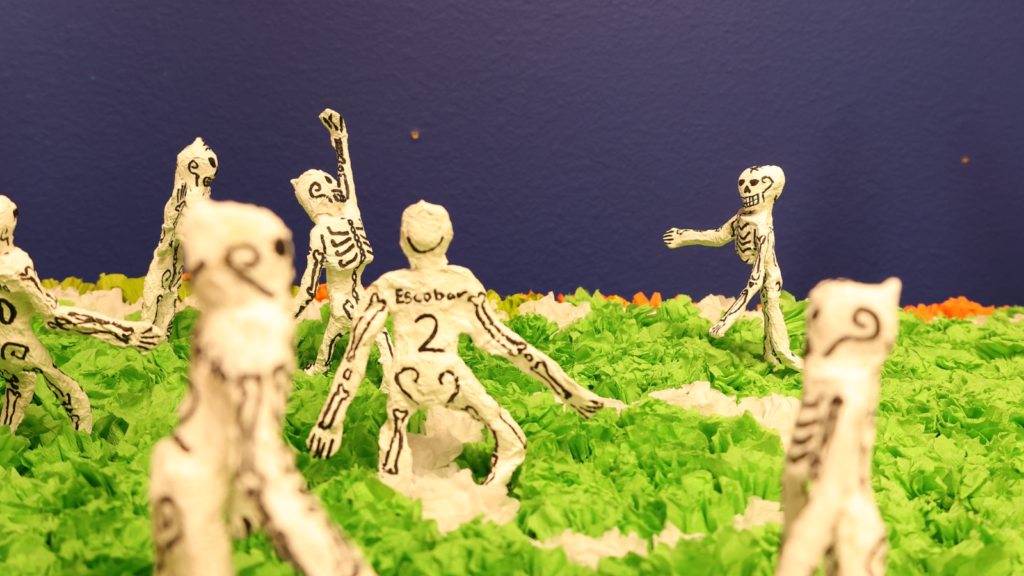
Soccer is an important aspect of South American culture that unites people through tradition and pride. In this altar we honor the memory of ten South American players that have left an unforgettable footprint in soccer and in our hearts. We hope that our altar offers a well-deserved homage to these soccer players and may their legacy never die.
El Legado Nunca Muere
Por: Andrea Cano Torres, Rosa Gamez and Carol Padilla, Bullard Dual Language Immersion, AP Spanish and Latinx Student Union
Dirección: Norte
Un grupo de estudiantes de la escuela Bullard inscritos en las materias de Español Avanzado con Inmersión Lingüística Dual, Lengua y Cultura Española de Nivel Avanzado (AP), Hablante de Lengua Materna II y la Unión de Estudiantes Latinos (LSU) ha creado este altar y estas ofrendas, bajo la dirección de nuestra talentosa artista local, Andrea Cano Torres.
Rosa Angélica Gámez, profesora de todas las materias mencionadas y asesora de la LSU de Bullard, en colaboración con Carol Padilla, coordinadora de la Unión de Estudiantes Latinos del Distrito.
Reseña de Ofrenda:
El fútbol es una parte importante de la cultura sudamericana uniendo a las personas mediante la tradición y el orgullo. En este altar honramos la memoria de diez futbolistas suramericanos que dejaron una huella inolvidable en el fútbol y nuestros corazones. Esperamos que nuestro altar les ofrezca un merecido homenaje a estos futbolistas y que su legado nunca muera.
East: Betty Rodriguez Library
3040 N Cedar Ave, Fresno, CA 93703
Guerreras Celestiales
Artist: Janel Claybon
Direction: East
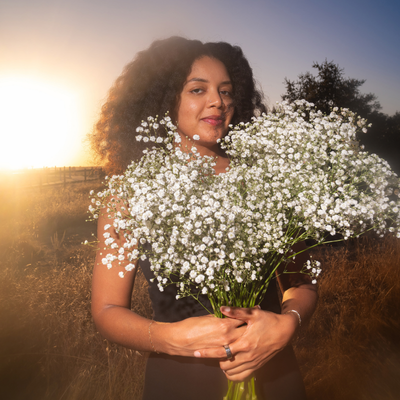
Janel Claybon is an artist based in Fresno, CA. Her primary focus is printmaking, specifically woodcut relief and lithography. Her artwork consists of themes related to her identity as a biracial Black and Mexican American woman, making spiritual connections with her roots, people, and objects within the Black and Mexican diaspora.
Ofrenda Statement:
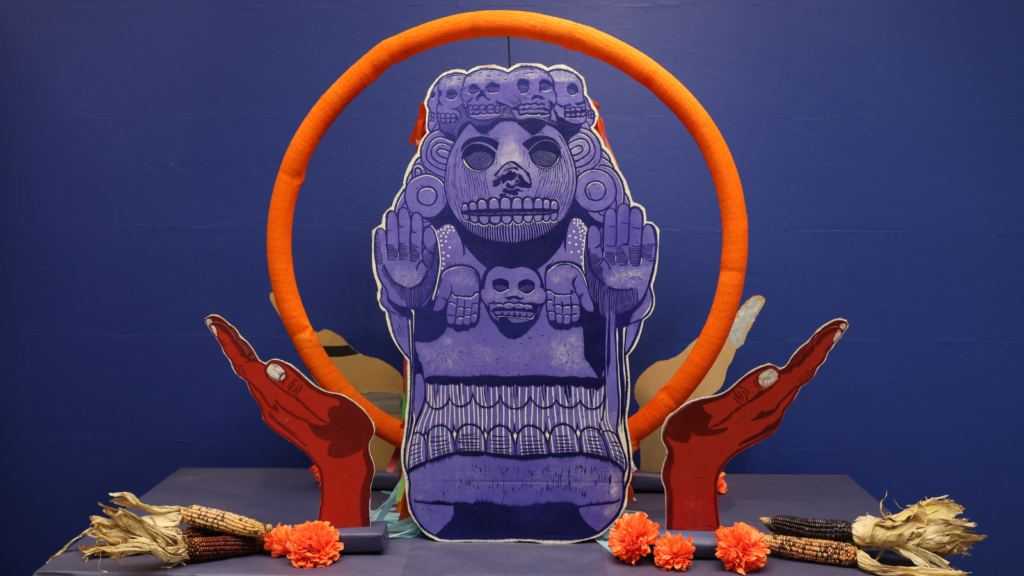
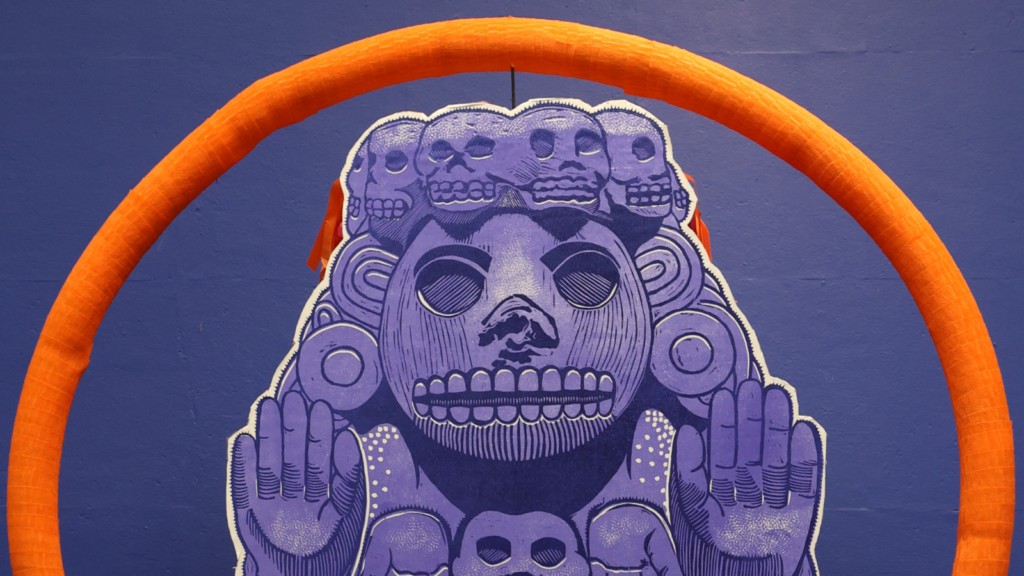
The ofrenda is dedicated to all birthing women/people who unfortunately did not make it during labor and delivery of their baby/babies. During the pre-Columbian era, these women were regarded as Cihuateteo (singular: Cihuateotl), which translates to “Divine Goddesses” in the classical Nahuatl language. The altar is symbolic of the East direction from Aztec mythology and the sun deity associated with it is Tonatiuh, also known as The Fifth Sun. With the assistance of Cihuateteo and fallen male warriors, Tonatiuh would rise in the East and set on the West. Cihuateotl, when in the heavens, is regarded as a Celestial Warrior for sacrificing their life in an attempt to bring their child into the world. This concept struck me strongly because everyday I work with pregnant Black women who are constantly fighting for their lives and for their unborn children. Although, the concept of Cihuateteo is traditionally reserved for pre-Columbian Mesoamerican culture, I believe that it can be applied to all birthing women/people because all birthing people, no matter their race, should be regarded with the same value of worth as any warrior on a battlefield.
Guerreras Celestiales
Por: Janel Claybon
Dirección: Este
Janel Clayborn es una artista basada en Fresno, California. Su especialidad es el grabado, sobre todo la litografía y el grabado en madera. Su obra aborda temas relacionados con su identidad como mujer birracial, negra y mexicoamericana, y con los vínculos espirituales que establece con sus raíces, su gente, y los objetos propios de las diásporas negra y mexicana.
Reseña de Ofrenda:
Esta ofrenda se dedica a todas las madres y personas embarazadas que lamentablemente fallecieron durante el parto y nacimiento de su(s) bebé(s). Durante las épocas precolombinas, estas mujeres se les consideraba como las Cihuateteo (en singular: Cihuatéotl), lo cual significa “Diosas Divinas” en la lengua Náhuatl clásica.
El altar simboliza la dirección del este de acuerdo con la mitología Azteca, y la deidad asociada a ella es Tonatiuh, también conocida como el Quinto Sol. Con el apoyo de las Cihuateteo y los hombres guerreros fallecidos, Tonatiuh subía en el Este y se ponía por el oeste.
Una Cihuatéotl, en los cielos, se considera como Guerrera Celestial por sacrificar su vida en el intento de dar luz a su bebé. Este concepto me impacto profundamente porque todos los días trabajo con mujeres negras embarazadas quienes luchan constantemente por sus vidas y las des sus hijos por nacer. A pesar de que el concepto de las Cihuateteo se reserva para la cultura precolombina Mesoamericana, yo creo que puede aplicarse pro que todas las mujeres y personas embarazadas, sin importar su raza, deben ser consideradas con el mismo valor que cualquier guerrero en el campo de batalla
Alma de este lado
Artist: Hella Fresno (Roeski Doeski and Jennie Guerrero)
Direction: East
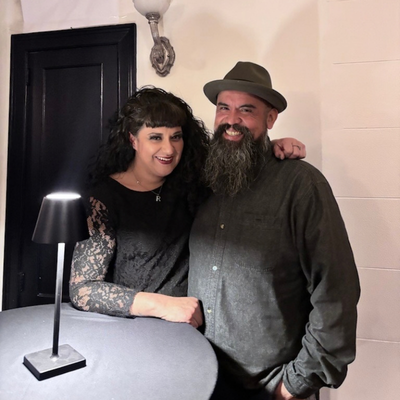
Born and raised in Fresno, Roeski Doeski and Jennie Guerrero co-own Hella Fresno Art Studio, in Downtown, they curate art shows and transform underutilized public spaces into galleries while celebrating the Central Valley’s finest artists. We love our city and proud to call it home!
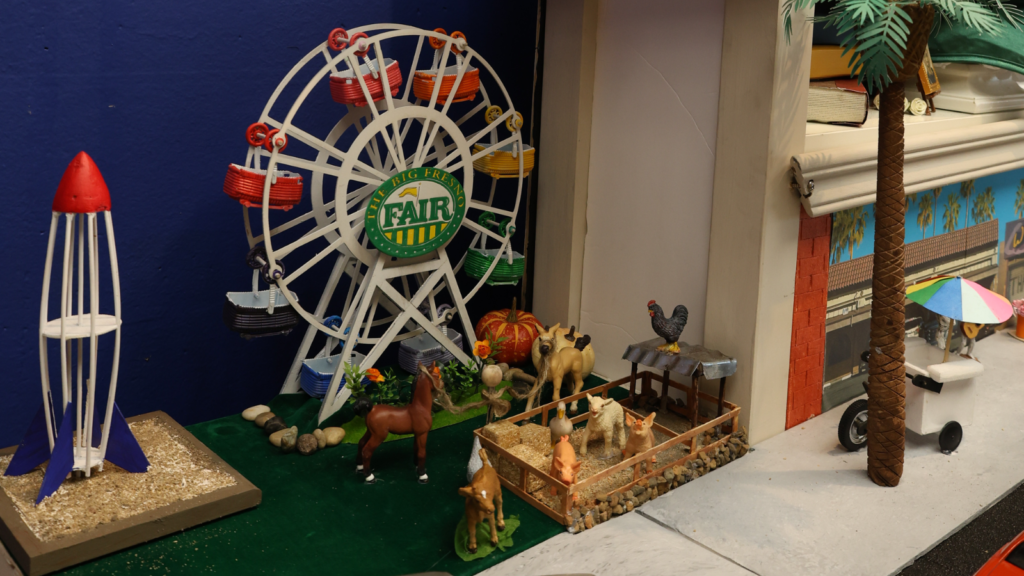
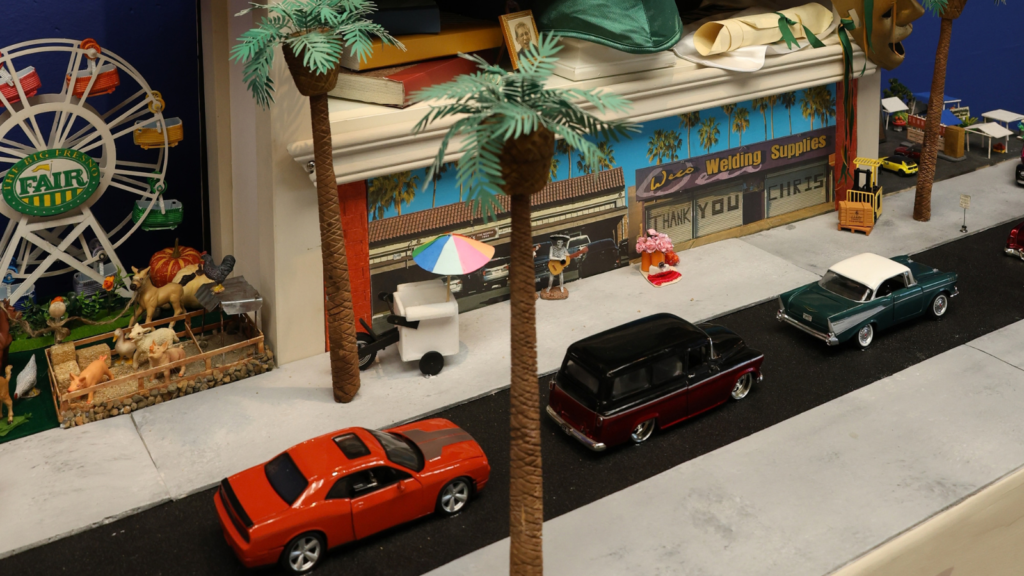
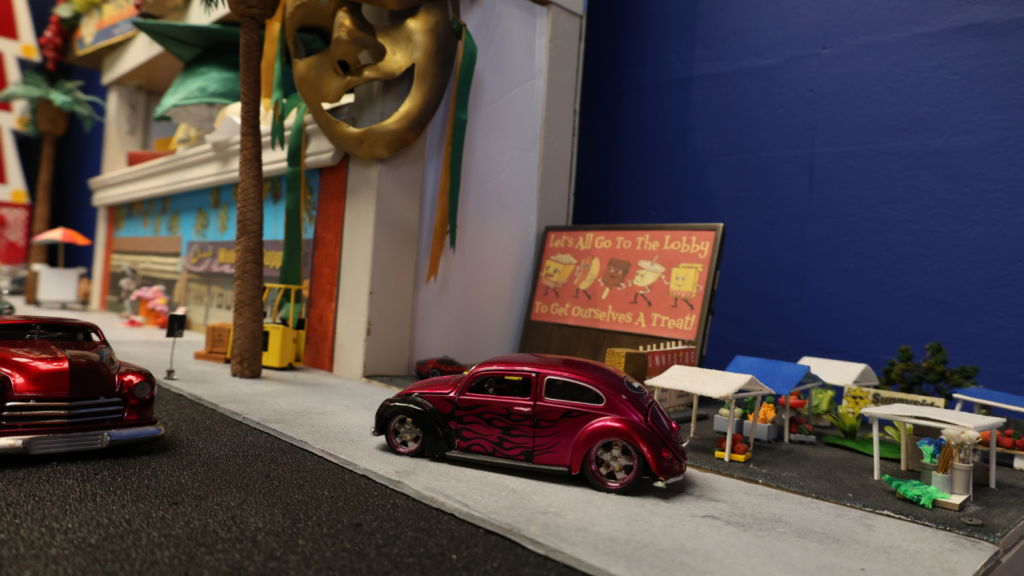
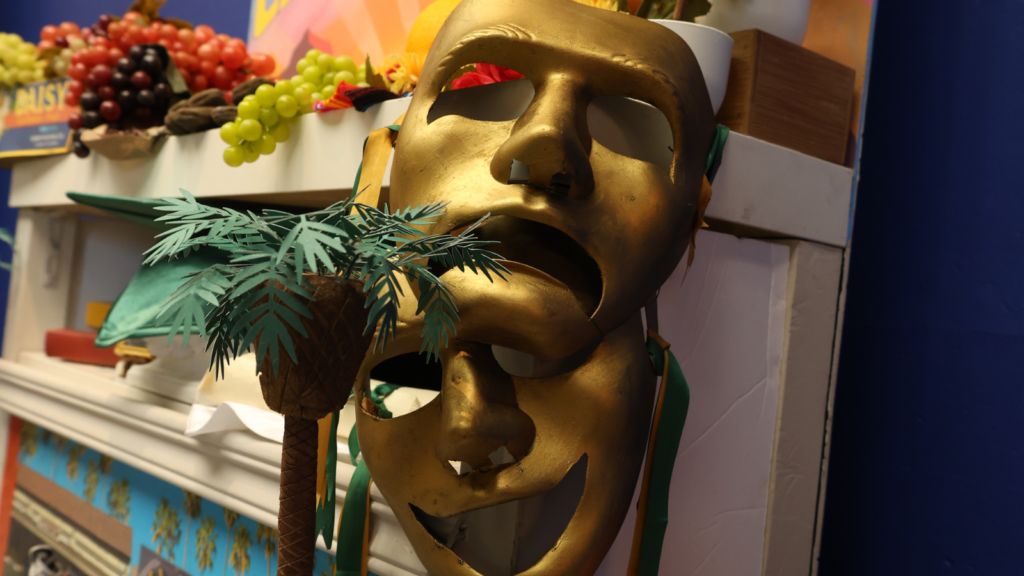
Ofrenda Statement:
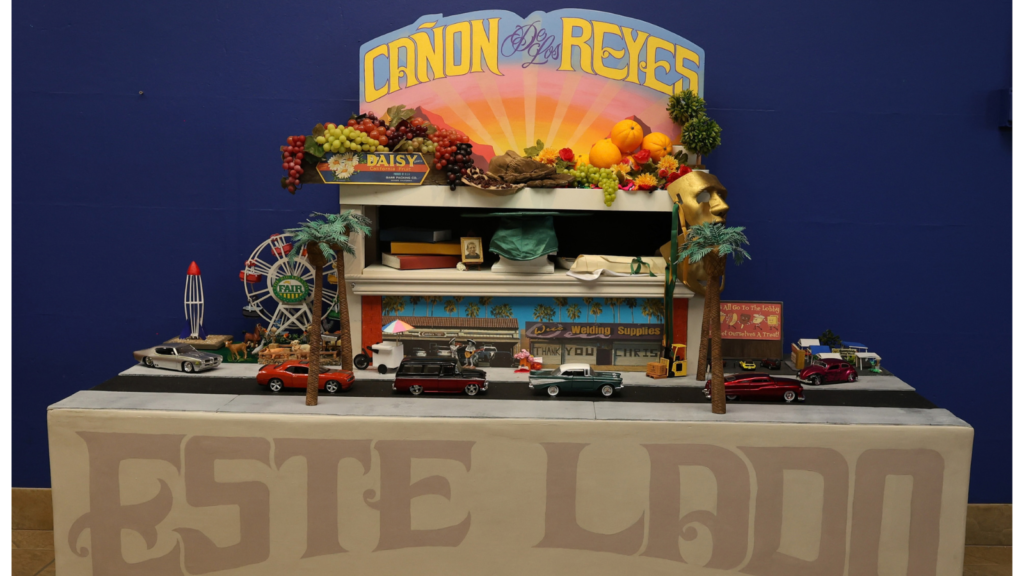
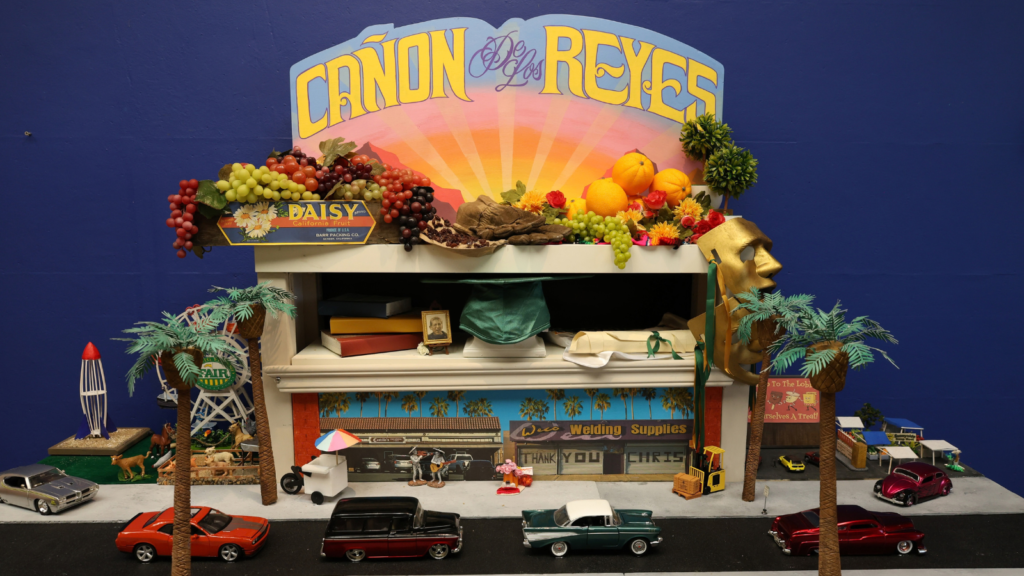
Born and raised on the East Side, this piece is my love letter to the boulevard—the lowriders cruising Kings Canyon, the palm trees cutting through the haze, the spots we grew up at, and the street grit that raised us. This ofrenda honors the real ones who came before us, holding down the history, the culture, and the spirit of our community. Hella East Side proud, always
Alma de este lado
Por: Hella Fresno (Roeski Doeski and Jennie Guerrero)
Dirección: Este
Nacidos y criados en Fresno, Roeski Doeski y Jennie Guerrero son propietarios de Hella Fresno Art Studio, ubicado en el centro de la ciudad. Organizan exposiciones de arte y transforman espacios públicos desaprovechados en galerías, al tiempo que rinden homenaje a los mejores artistas del Valle Central. ¡Amamos nuestra ciudad y estamos orgullosos de llamarla nuestro hogar!
Reseña de Ofrenda:
Esta obra, que nace y crece en el East Side, es mi carta de amor al bulevar: los automóviles lowriders que recorren Kings Canyon, las palmeras que se dibujan contra la neblina, los lugares donde crecimos y la esencia callejera que nos formó. Esta ofrenda rinde homenaje a aquellos que nos precedieron y que mantuvieron viva la historia, la cultura y el espíritu de nuestra comunidad. Con orgullo del East Side, siempre.
South: Mundo Pol
1418 Fulton St, Fresno, CA 93721
Huahi Cahi
Artist: Eden Santos
Ofrenda Direction: South
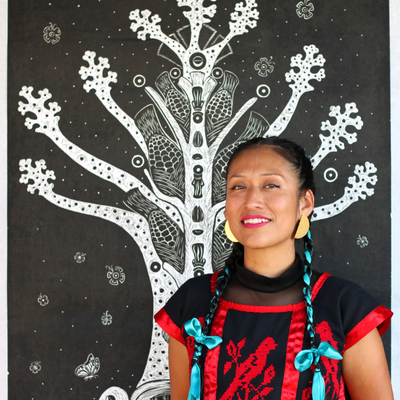
Edén Santos is a printmaker and multimedia artist whose work explores identity, memory, and storytelling shaped by her cultural background and lived experiences in Mexico and California’s Central Valley. She is an active member and collaborator with the Oval Gallery in Visalia, California.
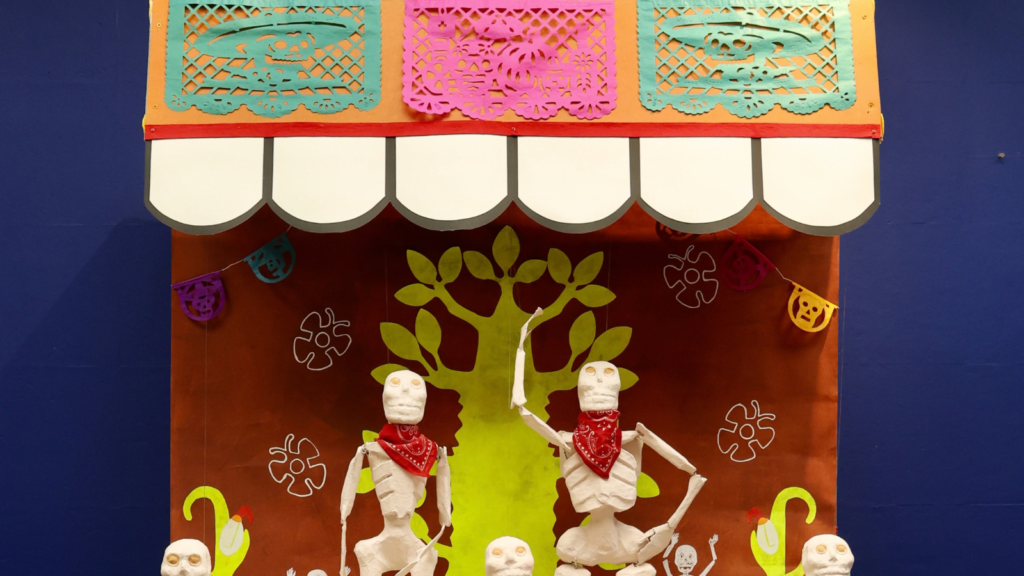
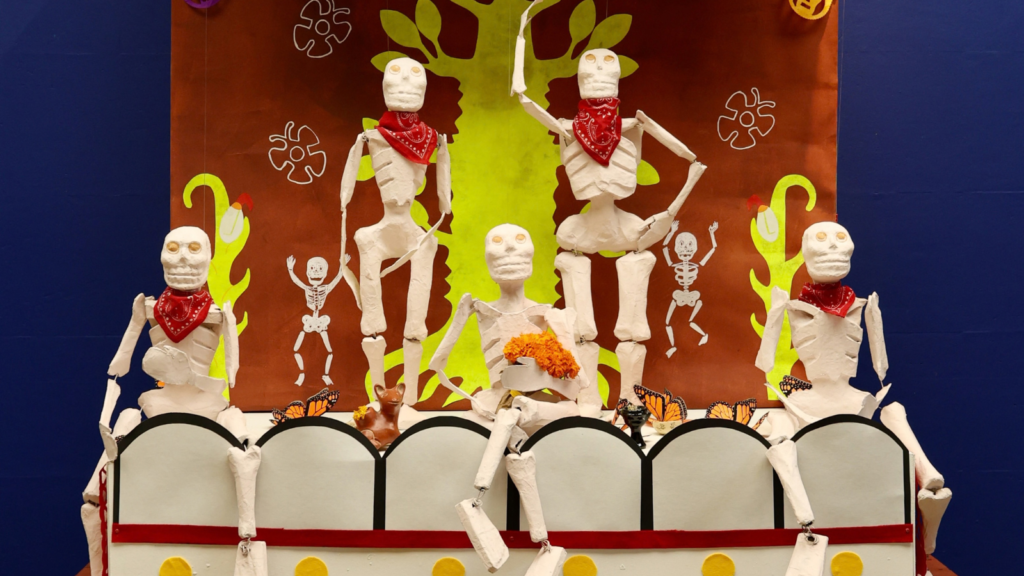
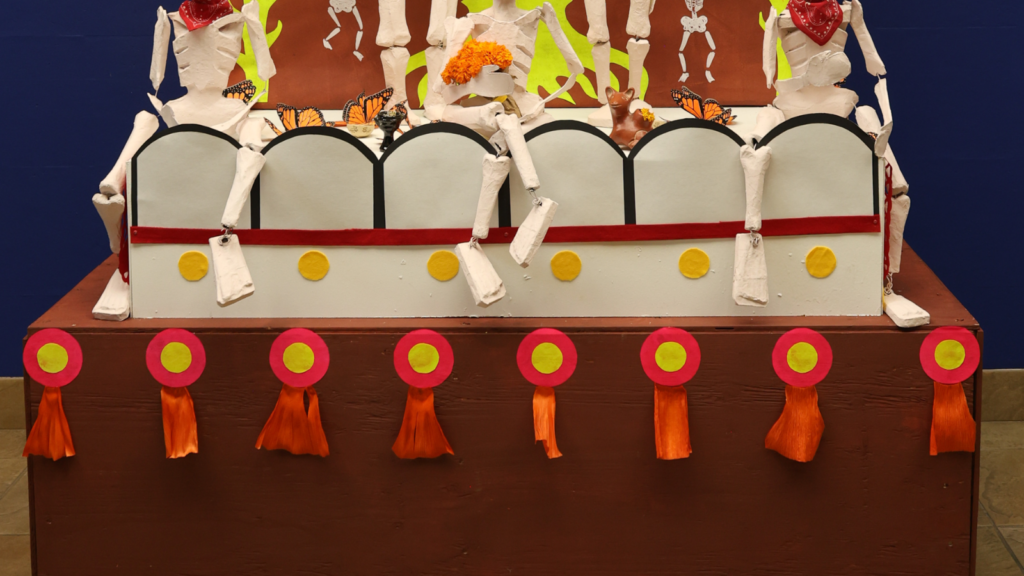
Ofrenda Statement:
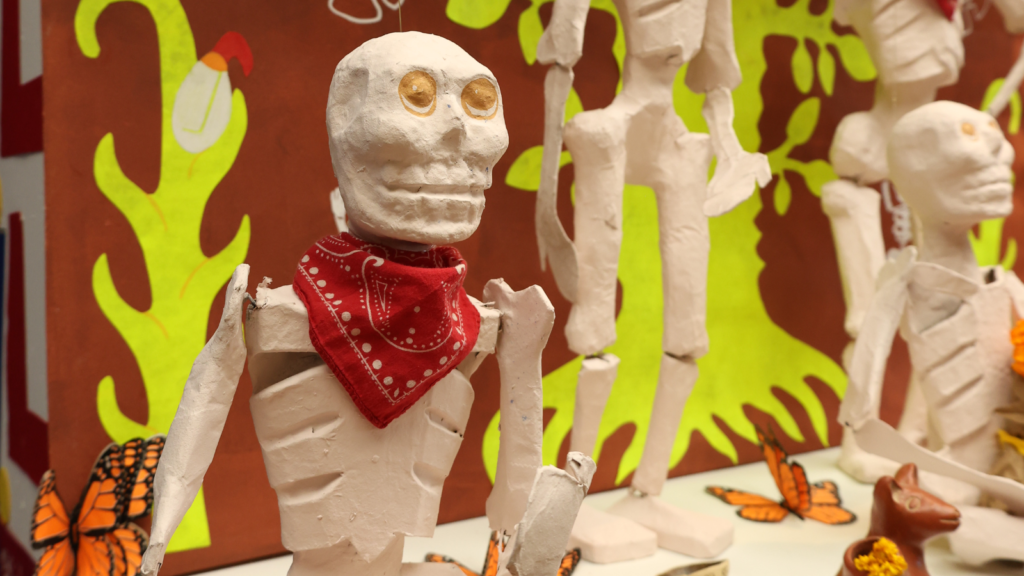
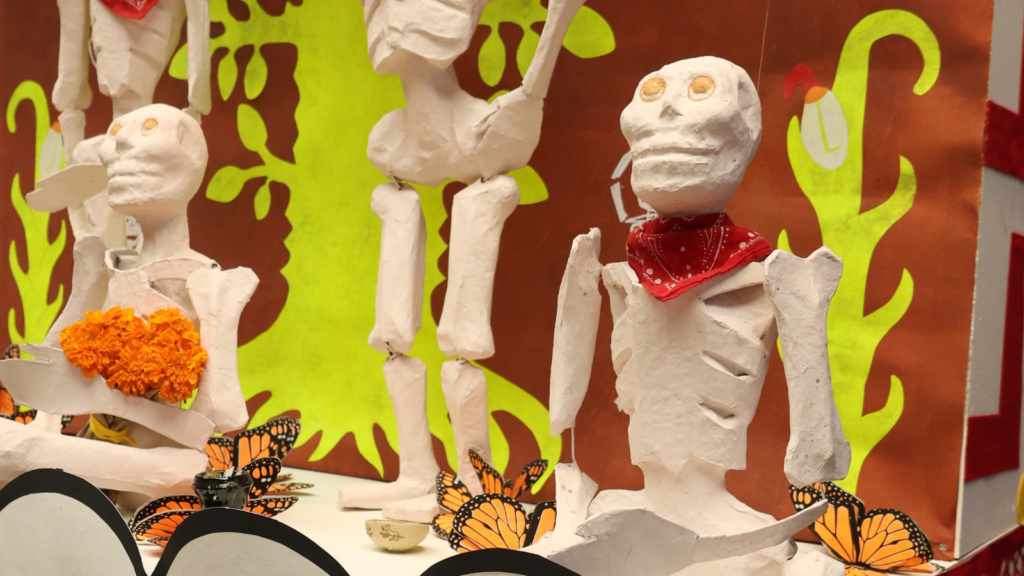
The ofrenda celebrates the Central Valley’s field workers feasting at the Huahi Cahi house, the South region of death in Mixteco or Ñuu Savi (rain people) culture- the indigenous people from northwest Oaxaca and parts of Puebla and Guerrero. In the Central Valley, people who work long hours in the fields come home and make time to grow their own food because their relationship with earth and food runs opposite to what industrial agriculture represents. Field workers carry ancestral knowledge inherent in their identity.
The love, care, and energy they put into growing food at home make neighborhoods come alive, and watching the seasons pass in their front yard is inspiring. Other field workers organize and build community gardens when soil and water resources in urban spaces are not accessible in their neighborhoods. All of them preserve and continue the relationship they’ve carried for centuries with earth, life cycles, and respect for the food and what we eat. Food is memory, medicine, spirituality, identity, and a way to perceive our relation with the universe. With this ofrenda, we honor the field workers, guardians of the earth, who treasure wisdom and ancestral knowledge and share it with the next generations.
Huahi Cahi
Por: Edén Santos
Dirección: Sur
Edén Santos es una artista multimedia y grabadora cuya obra explora la identidad, la memoria y la narración de historias, basadas en su herencia cultural y experiencias en México y el Valle Central de California. Es miembro activo y colaboradora de la Galería Oval en Visalia, California.
Reseña de Ofrenda:
Esta ofrenda rinde homenaje a los trabajadores agrícolas del Valle Central con un festejo en la casa de Huahi Cahi —la región del sur asociada a la muerte en la cultura mixteca o *Ñuu Savi* (pueblo de la lluvia), originaria del noroeste de Oaxaca y de partes de Puebla y Guerrero. En el Valle Central, quienes trabajan largas jornadas en el campo regresan a casa y dedican tiempo a cultivar sus propios alimentos, pues su vínculo con la tierra y la comida se opone a lo que representa la agricultura industrial. Los trabajadores agrícolas portan un saber ancestral inherente a su identidad.
El amor, el cuidado y la energía que dedican al cultivo de alimentos en casa revitalizan los vecindarios, y es inspirador observar el paso de las estaciones en sus jardines. Otros trabajadores se organizan para crear huertos comunitarios cuando los recursos básicos, como la tierra y el agua, en sus propios vecindarios no son accesibles. Todos ellos preservan y mantienen viva una relación centenaria con la tierra y con los ciclos de la vida, basada en el respeto hacia los alimentos y hacia lo que consumimos.
La comida es memoria, medicina, espiritualidad, identidad y una forma de percibir nuestra relación con el universo. Con esta ofrenda honramos a los trabajadores agrícolas —guardianes de la tierra—, quienes atesoran sabiduría y conocimientos ancestrales para compartirlos con las futuras generaciones.
Cosecha de los abuelos
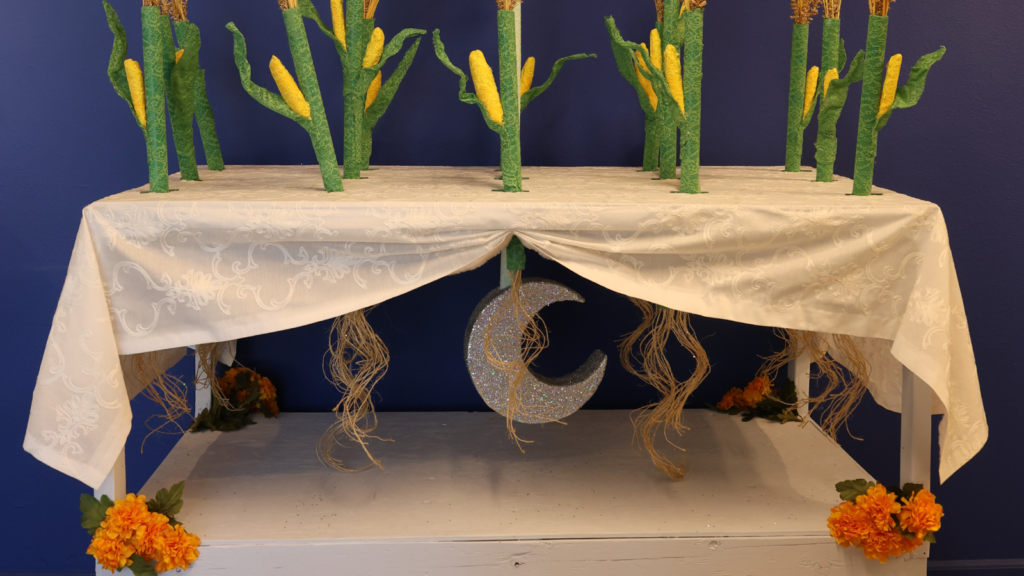
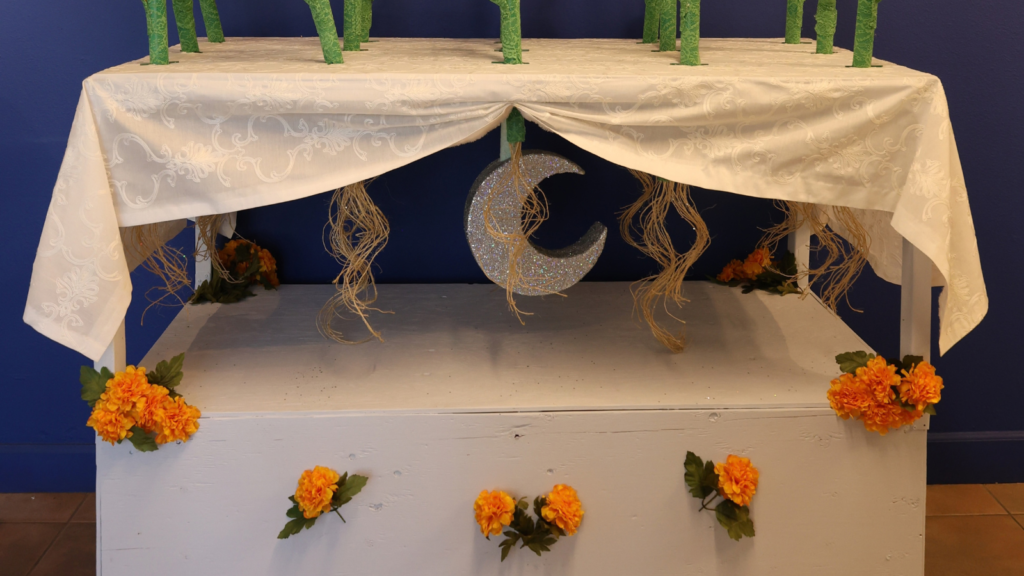
Artists: Amy Díaz-Infante Siqueiros
Ofrenda Direction: South
Amy Díaz-Infante Siqueiros is a socially engaged narrative artist and educator working in the California Bay Area. Her works explore time and cultural memory as carried through the body, ritual, food, flora, oral history, and humor. She holds a BA in Art from Yale University, and an MFA from the Rhode Island School of Design.
Ofrenda statement:
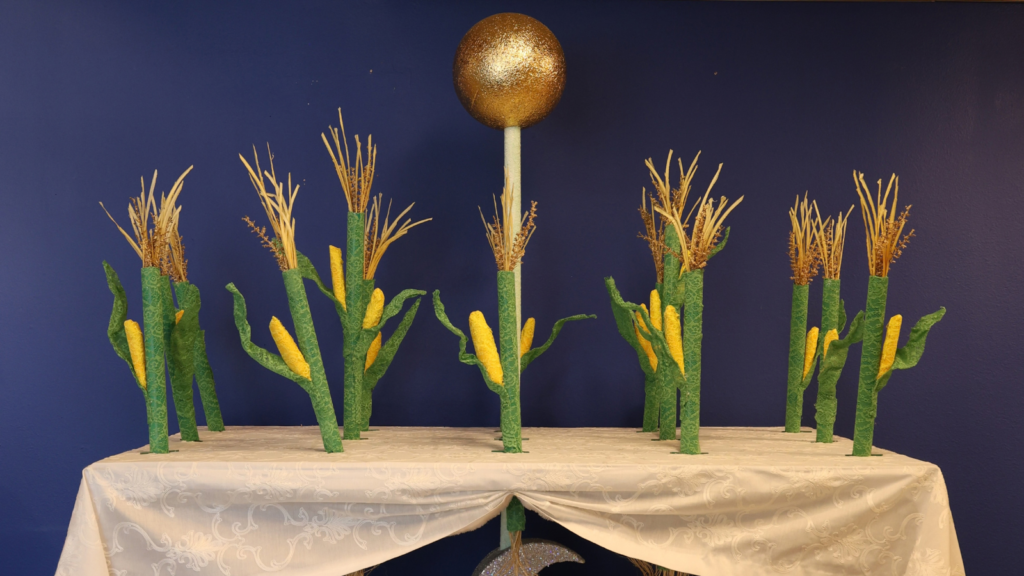
In Mesoamerican traditions, the South is generally associated with youth, the harvest, the midday sun, and summer. In my altar, Cosecha de los abuelos, I am thinking both of youth and of grandparents – how they prepare the soil for the coming generations, and how they tend to their development. Elders are associated with the North, and this duality between generations and the cyclical nature of life and death is how we both pass on knowledge and tradition; but also stretch and adapt to create new cultural systems. This altar honors our intergenerational communities and how we sustain each other.
In this altar, I’m also recalling the literal cultivation and sustenance that was part of my grandparents’ home. My grandpa nurtured plants in his garden that would then nourish our family in the many meals that my grandparents prepared and shared with us at their table. The kitchen table itself is also an altar where we offer food, share stories, and bind family.
My grandparents knew what they were doing in the kitchen and I am so thankful for all the joy that came out the delicious meals that they provided. This food and the ceremonies of the kitchen around preparing, presenting, and ingesting shared meals fed me both body and soul as they connected me even further back to countless generations of ancestors.
This altar is in memory of my paternal grandparents, Luis and Evelia Díaz-Infante. I thank the family that helped me raise this altar – especially my husband Gabriel Siquerios, and our twins Ximena and Diego (who especially liked the glitter). This altar is dedicated to all grandparents and their special bond with their grandchildren.
Cosecha de los abuelos
Por: Amy Díaz-Infante Siqueiros
Dirección: Sur
Amy Díaz-Infante Siqueiros es una artista narrativa y educadora comprometida con la práctica social, radicada en el Área de la Bahía de California. Su obra explora el tiempo y la memoria cultural a través del cuerpo, los rituales, la comida, la flora, la historia oral y el humor. Cuenta con una licenciatura en Arte por la Universidad de Yale y una maestría en Bellas Artes por la Rhode Island School of Design.
Reseña de Ofrenda:
En las tradiciones Mesoamericanas, el sur comúnmente se relaciona con la juventud, la cosecha, el sol del mediodía, y el verano. En mi altar, Cosecha de los Abuelos, pienso tanto en los jóvenes como los abuelos – como ellos preparan el terreno para las próximas generaciones y cómo cuidan su desarrollo. Las personas mayores se relacionas con el norte, y esta dualidad entre las generaciones y la esencia cíclica de la vida y la muerte es cómo transferimos nuestros conocimientos y tradiciones; pero también para crecer y adaptar nuevos sistemas culturales. Este altar honra nuestras comunidades intergeneracionales y como nos apoyamos mutuamente.
A través de este altar, evoco al cultivo y sustento que formó parte literal del hogar de mis abuelos. Mi abuelo cuidaba sus plantas en el jardín, las que después alimentaban a nuestra familia en las numerosas comidas que mis abuelos preparaban y compartían con nosotros en su mesa. La mesa de la cocina en si misma también es un altar donde se ofrece comida, se comparten historias, y se estrechan los lazos familiares.
Mis abuelos sabían muy bien lo que hacían en la cocina y estoy muy agradecida por toda la felicidad que me brindaron con las comidas deliciosas que preparaban. Esta comida que compartimos y los rituales de la cocina, desde la preparación hasta la presentación y degustación – me alimentaron tanto en mi cuerpo y alma, mientras me conectaban aún más con innumerables generaciones de antepasados.
Este altar es dedicado a mis abuelos paternos, Luis y Evelia Díaz-Infante.
Agradezco a la familia que me ayudó a montar este altar– especialmente a mi esposo Gabriel Siquerios, y a nuestros gemelos, Ximena y Diego (quienes especialmente apreciaron la brillantina). El altar se dedica a todos los abuelos y el lazo especial con sus nietos.
West: Fresno Chaffee Zoo
894 W Belmont Ave, Fresno, CA 93728
OCASO: The Rest of the Soul
Artist: Juan José Valdez Hirales
Ofrenda Direction: West
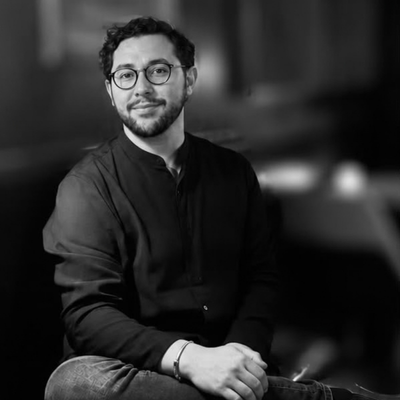
Juan José Valdez Hirales is originally from Mexicali, Baja California, Mexico, and is a professional in International Relations. His interest in Mexican culture and traditions has grown over the years, particularly through his work and close connection with the Mexican community in California, leading him to find in Día de Muertos and the creation of ofrendas a way to experiment, learn, and reconnect with his own roots. In recent years, he has participated in several ofrenda projects and competitions and has received recognition from the Government of Mexico.
Ofrenda statement:
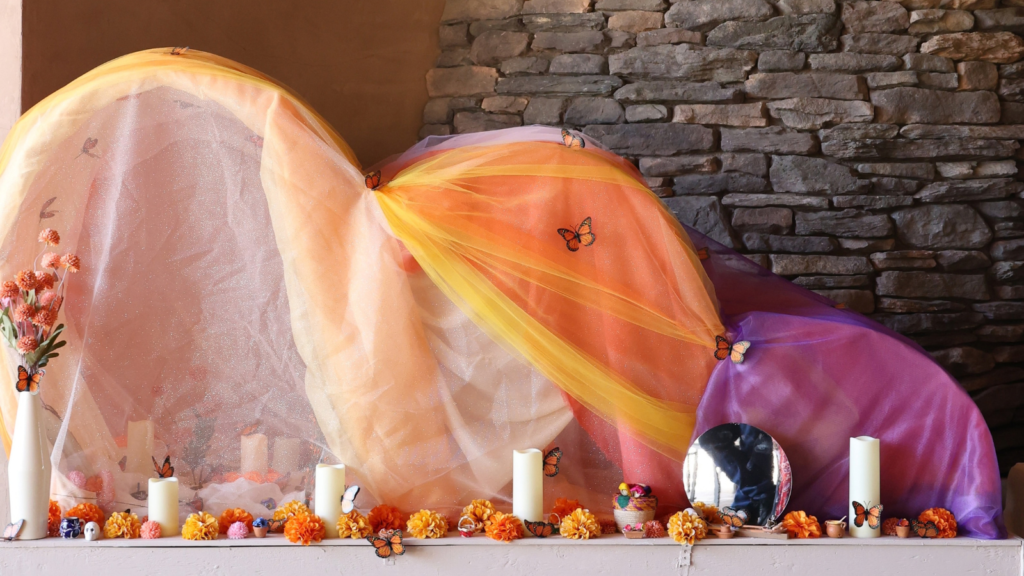
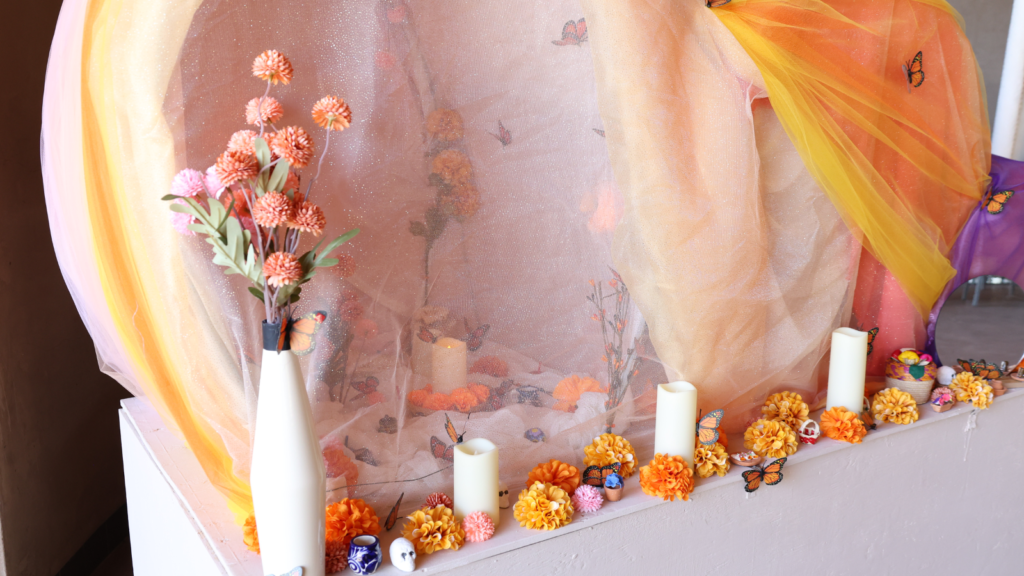
I have always understood an ofrenda as a space to remember and feel close to those who are no longer with us. When I think of Día de Muertos, I think of flowers, candles, photographs, food, and all the objects we carefully place because they once meant something to someone. With OCASO: The Rest of the Soul, I wanted to preserve that essence while representing it in a different way.
Of the four cardinal directions, I chose the West because it immediately made me think of sunset. Living in California’s Central Valley has allowed me to watch the sky slowly transform before nightfall—from yellow and orange to pink, mauve, and violet—until the light finally disappears. We watch the sun leave every day, yet we never think it has ceased to exist; we simply can no longer see it.
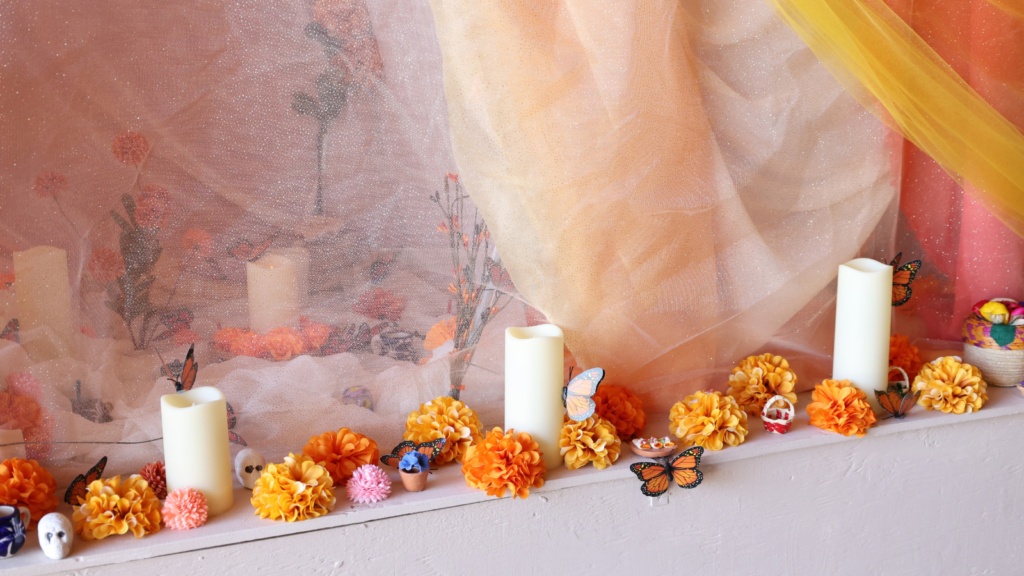
The piece imagines sunset as a threshold between day and night, and the West as a place of rest. A large mantle rises above the platform and gradually descends toward the West, as though finally resting upon the earth. A warm light remains within its folds, while marigolds, seeds, water, and earth become increasingly subtle.
This ofrenda is not dedicated to one particular person, but to the memory of those who have passed. As the form descends, the elements diminish until they give way to a quieter, more open space. For me, that emptiness does not mean absence. It means rest.
OCASO does not attempt to answer what happens after death. It begins with a much simpler idea: that remembering can also be a way of keeping close those we can no longer see—like the sun that disappears into the West every evening and yet, somehow, we know is still there.
OCASO: El descanso del alma
Por: Juan José Valdez Hirales
Dirección: Oeste
Juan José Valdez Hirales es originario de Mexicali, Baja California, México, y profesional de las Relaciones Internacionales. Su interés por las tradiciones y la cultura mexicana ha crecido a través de los años, particularmente mediante su trabajo y cercanía con la comunidad mexicana en California, encontrando en el Día de Muertos y en la creación de ofrendas una forma de experimentar, aprender y acercarse a sus propias raíces. En los últimos años ha participado en diversos proyectos y concursos de ofrendas, recibiendo reconocimientos del Gobierno de México.
Reseña de Ofrenda:
Siempre he entendido la ofrenda como un espacio para recordar y sentir cerca a quienes ya no están. Cuando pienso en Día de Muertos, pienso en flores, velas, fotografías, comida y en todos aquellos objetos que colocamos con cariño porque alguna vez significaron algo para alguien. Con OCASO: El descanso del alma quise conservar esa esencia, pero representarla de una manera diferente.
De los cuatro puntos cardinales elegí el Oeste porque me hizo pensar inmediatamente en el atardecer. Vivir en el Valle Central de California me ha permitido observar cómo, antes de anochecer, el cielo se transforma lentamente del amarillo y naranja al rosa, malva y violeta, hasta que finalmente la luz desaparece. Vemos al sol irse todos los días, pero nunca pensamos que ha dejado de existir; simplemente dejamos de verlo.
La pieza imagina el ocaso como un umbral entre el día y la noche, y al Oeste como un lugar de descanso. Un gran manto se eleva sobre la plataforma y desciende gradualmente hacia ese punto cardinal, como si finalmente se recostara sobre la tierra. Entre sus pliegues permanece una luz cálida, mientras el cempasúchil, las semillas, el agua y la tierra aparecen de manera cada vez más sutil.
Esta ofrenda no está dedicada a una persona en particular, sino a la memoria de quienes han partido. Conforme la forma desciende, los elementos disminuyen hasta dejar un espacio más abierto y tranquilo. Para mí, ese vacío no significa ausencia. Significa descanso.
OCASO no pretende responder qué sucede después de la muerte. Parte de una idea mucho más sencilla: que recordar también es una manera de mantener cerca a quienes ya no podemos ver. Como el sol que desaparece cada tarde por el Oeste y que, aun así, sabemos que sigue ahí.
The Long Way Home
Artist: Camille Herrera-Cockerham
Direction: West
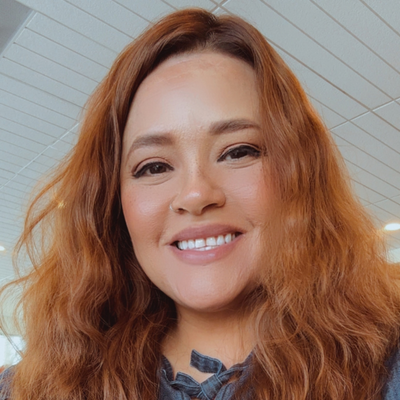
Camille is a multidisciplinary artist based in Fresno, CA. Their work draws inspiration from lived experiences as a BIPOC queer artist living in Central California. Some of their specialties include; painting, photography, poetry, mixed media, collage, costume making, fashion design, and craft.
Ofrenda Statement:
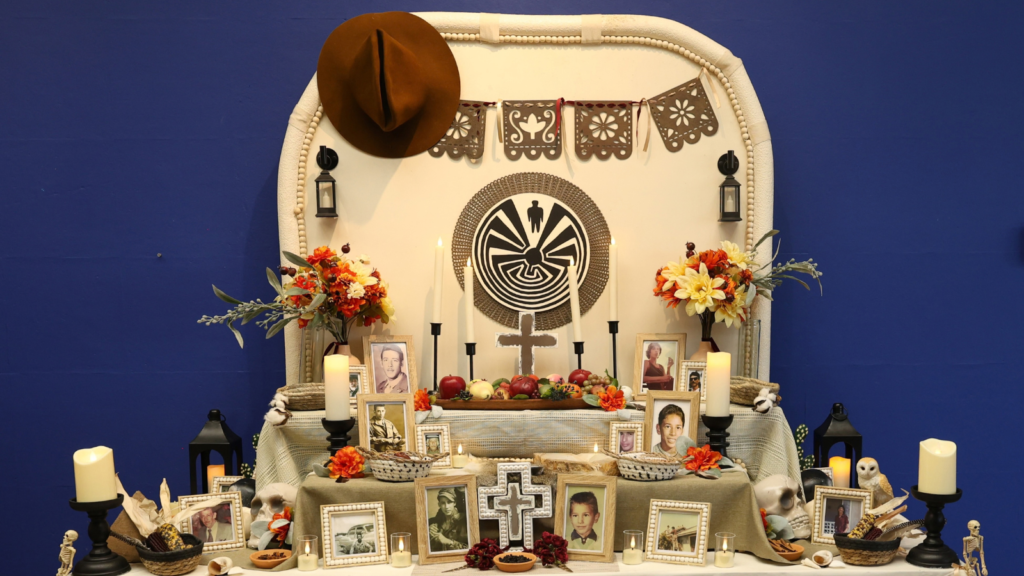
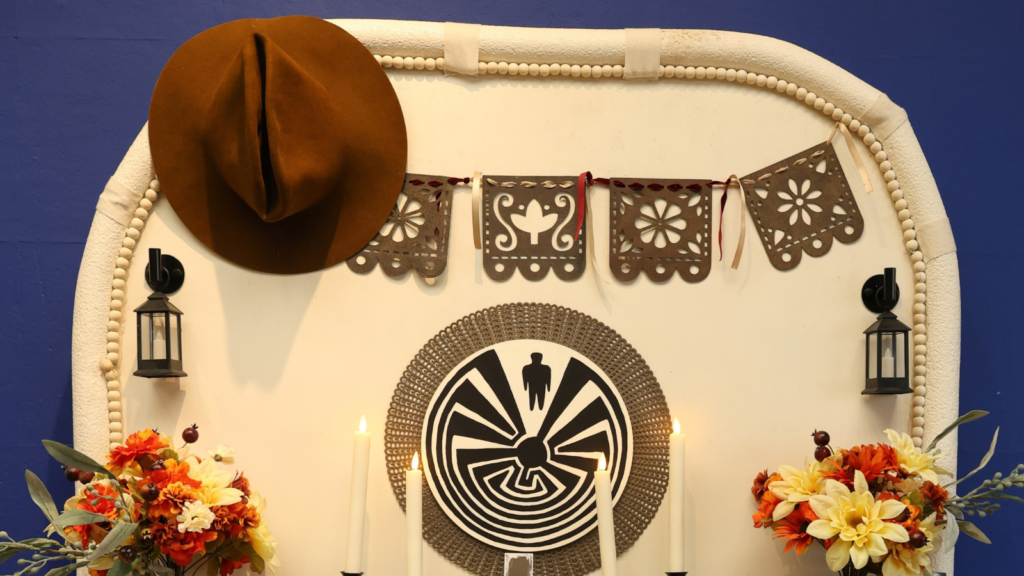
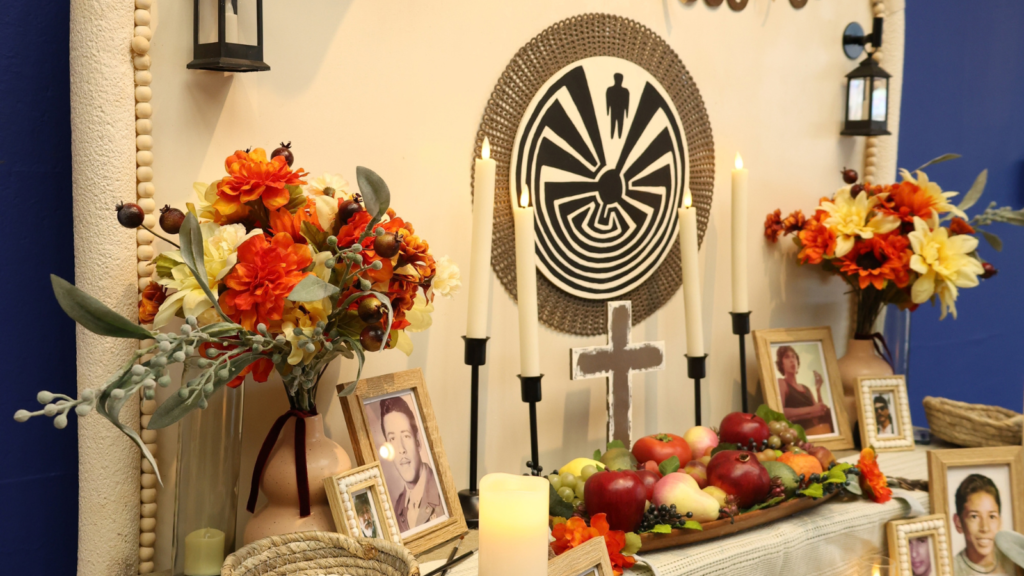
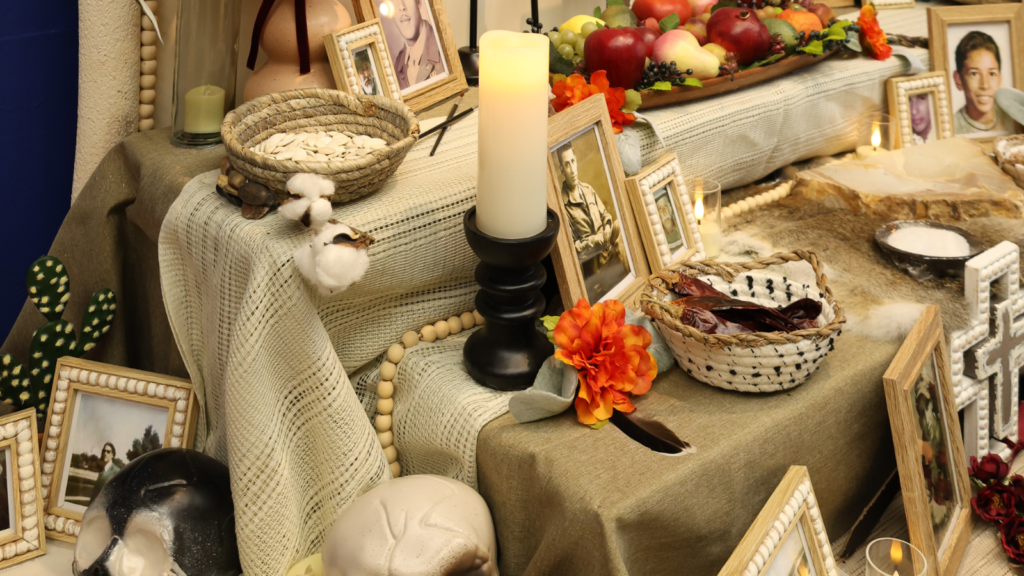
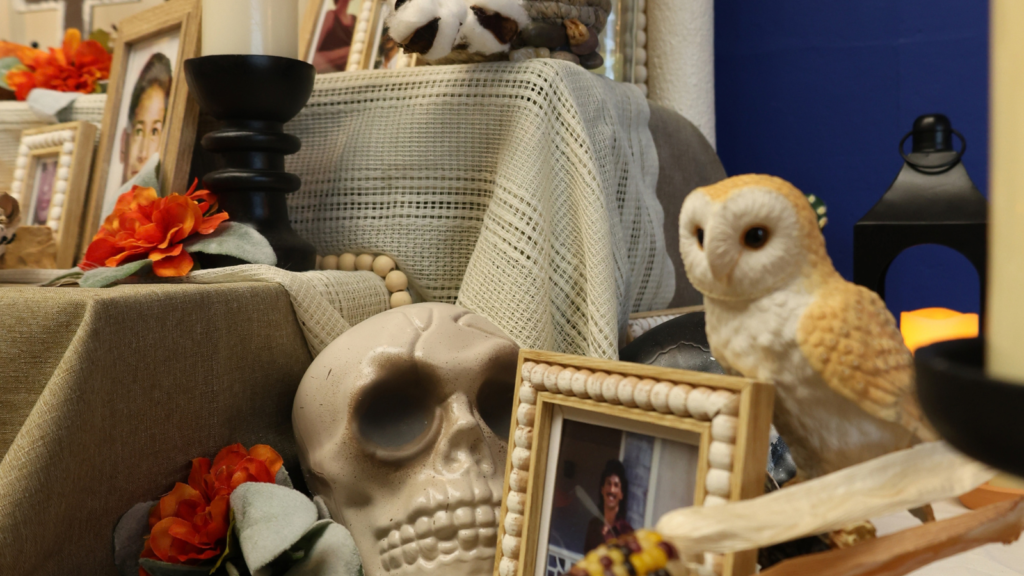
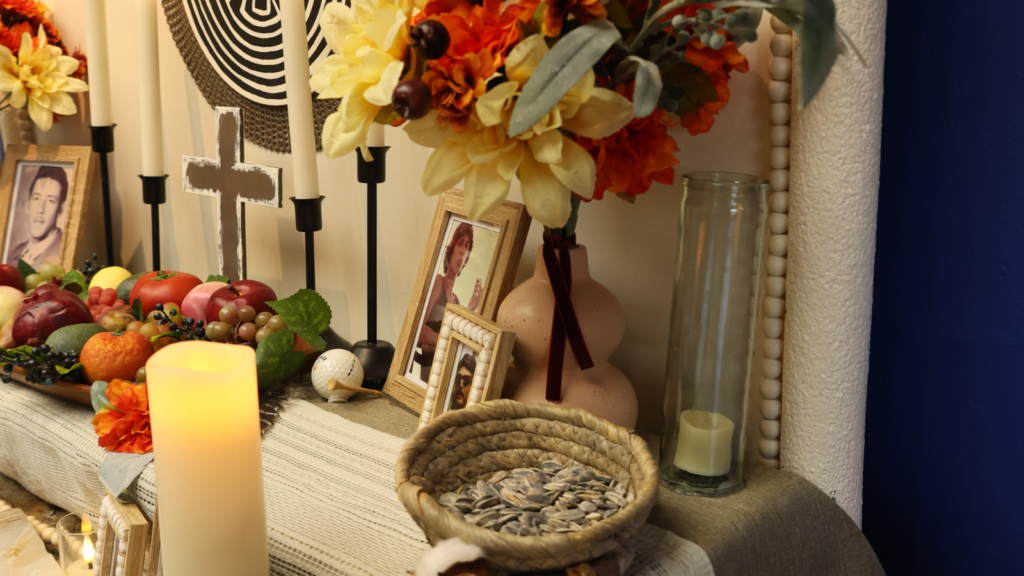
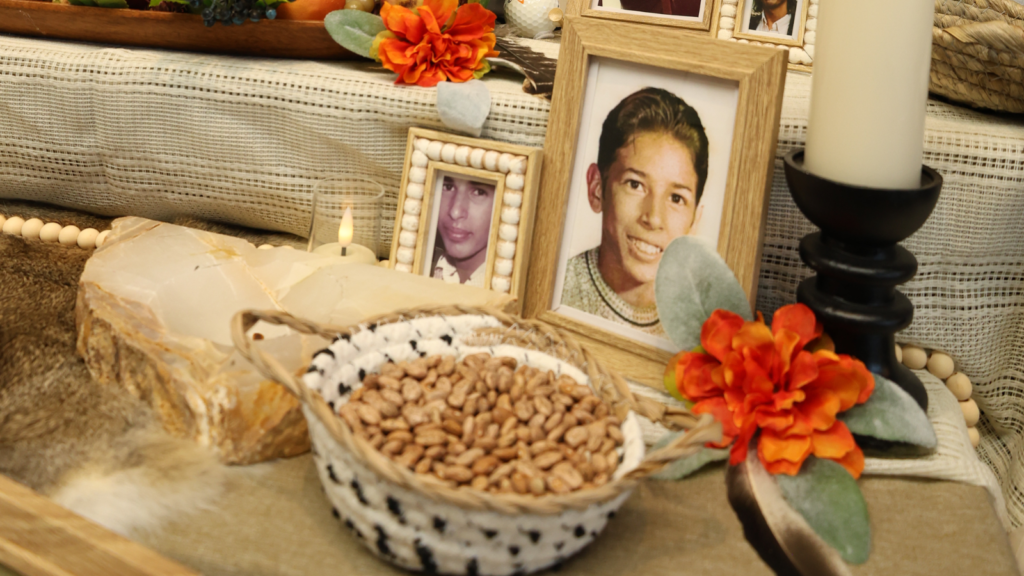
This ofrenda honors my father & grandfather, whom I lost at age 9 & 7. These losses profoundly shaped my understanding of life, death, family, and the passing down—and sometimes the breaking—of ritual and tradition. This work highlights both the beauty and the struggle of carrying traditions forward while still searching for a sense of belonging within one’s ancestral culture.
A main focal point of my ofrenda is the sacred Man in the Maze symbol, from my grandfather’s Tohono O’odham ancestry, which represents a person’s life journey. The winding path symbolizes the choices, challenges, and experiences encountered throughout life until one reunites with the creator.
My ofrenda is an invitation to remember, honor, and reconnect with the people, places, and histories that continue to orient us. It asks how we carry those who came before us, and how home is not a place we return to, but also a direction that continually guides us back to ourselves.
El Camino Largo a Casa
Por: Camille Herrera-Cockerham
Dirección: Oeste
Camille es una artista multidisciplinaria que vive en Fresno, California. Su obra se inspira en sus experiencias personales como artista perteneciente a la comunidad BIPOC (Personas negras, indígenas y personas de color) y queer que vive en California Central. Sus especialidades incluyen: la pintura, fotografía, poesía, técnicas mixtas, collage, diseño de vestuario, diseño de moda y artesanías.
Reseña de Ofrenda:
Esta ofrenda rinde homenaje a mi padre y a mi abuelo, quienes perdí cuando a los 9 y 7 años. Estas pérdidas formaron profundamente mi entendimiento de la vida, la muerte, la familia, y la continuidad – y, a veces, la ruptura – de los rituales y la tradición. La obra resalta tanto la belleza como la lucha mantener vivas las tradiciones mientras seguimos buscando un sentido de pertenencia dentro de la cultura ancestral propria.
Un punto central de mi ofrenda es el símbolo sagrado del ‘Hombre en el Laberinto’ que proviene de la ascendencia Tohono O’odham de mi abuelo y representa el transcurso de la vida de una persona. La ruta sinuosa simboliza las decisiones, los retos, y las experiencias que uno encuentra a lo largo de la vida hasta que uno se reúne con el creador.
Mi ofrenda invita a recordar, honrar, y reconectar con las personas, lugares, e historias que continúan guiándonos. Nos pregunta cómo recordamos a nuestros antepasados, y cómo el hogar no es solo un lugar al que regresamos, sino también una dirección que nos guía continuamente de regreso a nosotros mismos.